
Blume Lempel's Stories: Surviving Yiddish Women Writers' Erasure

Updated: May 15
Sunday May 17, 2026 3-5 pm Pacific

With Special Guests:
Translators
Ellen Cassedy and
Yermiyahu Ahron Taub
The newly translated Yiddish women writers like Blume Lempel were not born yesterday. Like Lempel, most emigrated as young women from Eastern Europe, settling in North America's urban centers after the turn of the 20th century.
Many of these Yiddish women writers are now being translated and published in English, in what appears to be a renaissance of interest. This is the case with Lempel's stories, which were published in Yiddish literary journals through the 1970s, and then published as collected works in 1981 and 1986. Ellen Cassedy and Yermiyahu Ahron Taub compiled and translated the short stories, publishing them as a book in 2016. They gave the book the title of Lempel's most audacious story, Oedipus in Brooklyn, a matter-of-fact and not unsympathetic account of mother-son incest.
A New York Times article on February 6, 2022 alleges that decades ago, works written in Yiddish by female Jewish writers, often immigrants, "were dismissed as insignificant or unmarketable." The article notes that "in the past several years," translators who love the literature are making it available to a wider readership. How long ago is "decades ago" and how recent is "in the past several years?" And who were the gatekeepers who either published or dismissed works by Yiddish women writers?
Take Lempel's wartime novel Tvishn Tsvey Veltn (Between Two Worlds), which was originally serialized in a Yiddish newspaper in 1947. In 1954, Philosophical Library issued a translation retitled as Storm Over Paris by "Blanche" Lempel. (No translator is credited.) What was Philosophical Library and how did it come to publish Lempel's work? Wikipedia describes Philosophical Library as a New York publisher founded in 1941 specializing in psychology, philosophy, religion, and history.
Philosophical Library, which remains in business, was conceived and founded by philosopher Dagobert D. Runes, a member of the Viennese logical positivist circle, and a Jew. He was born in 1902 in Bukovina (then Austria-Hungary, now Ukraine), the neighboring oblast to that in which Lempel's home town in the region of Galicia was located. Lempel was born in 1907. Runes founded Philosophical Library, to quote Wikipedia, "with the intention of publishing the works of European intellectuals fleeing racial and religious persecution in the 1930s."
The Philosophical Library published luminaries such as Einstein, Sartre, de Beauvoir, Schoenberg, Planck, Yogananda, Gibran, and Schweitzer. Strangely, or not strangely, Blume (Blanche) Lempel's portrait and name are missing from the roster of authors displayed on the Philosophical Library website. I'll add, without surprise, that all the authors published by Philosophical Library are male, with the exception of Simone De Beauvoir, whose portrait and name remain.
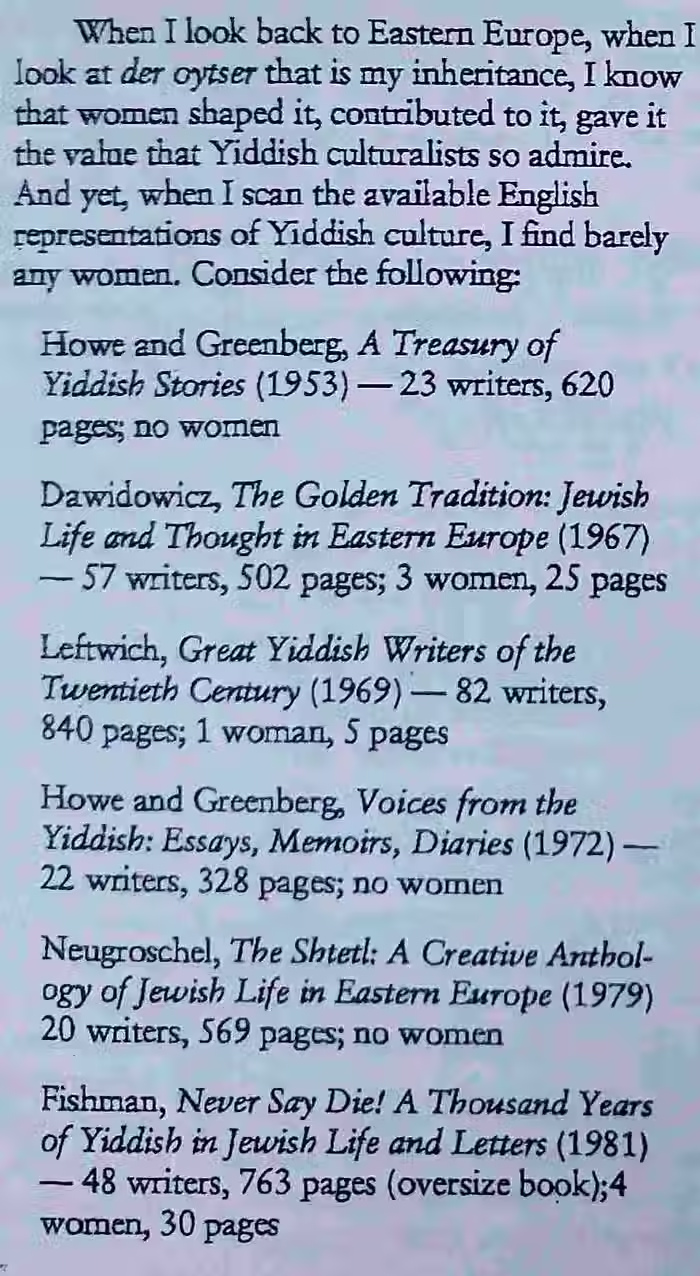
My point is that publication and translation of works by women in Yiddish has a trajectory reaching deep into the last century. It is a sinuous line. A dotted line. It is the old story of patriarchal gatekeepers, of a few powerful literary allies who went against the grain, the decline of the Yiddish press that serialized stories for eager readers, the loss of those readers (of which Bashevis Singer spoke indelibly in his Nobel Prize acceptance speech). But the reading and translation of women's work is not exactly a new project in Yiddishland.
Yiddish writers and scholars who are women have been, so far, the predominant caretakers (caregivers!) of Jewish women's writing and women's writing in Yiddish. I am posting the groundbreaking 1980 article, Culture and Radical Politics: Yiddish Women Writers, 1890-1940 by Norma Fain Pratt. Irena Klepfisz's landmark 1994 article on Yiddish women writers, Di Mames, Der Loshn is also posted here. The first part of the article preciently talks about secular Bundism as an alternative to Zionism in Israel/Palestine. In the second and third parts, from p. 17 on, Klepfisz presents the evidence of Yiddish women writers' marginalization from the Jewish canon and four exemplars.



Comments